-
Loyalty Points

-
Stamp Programmes

-
Sign In

-
Basket
 0 item(s) - £0.00
Your shopping cart is empty!
0 item(s) - £0.00
Your shopping cart is empty!
 0 item(s) - £0.00
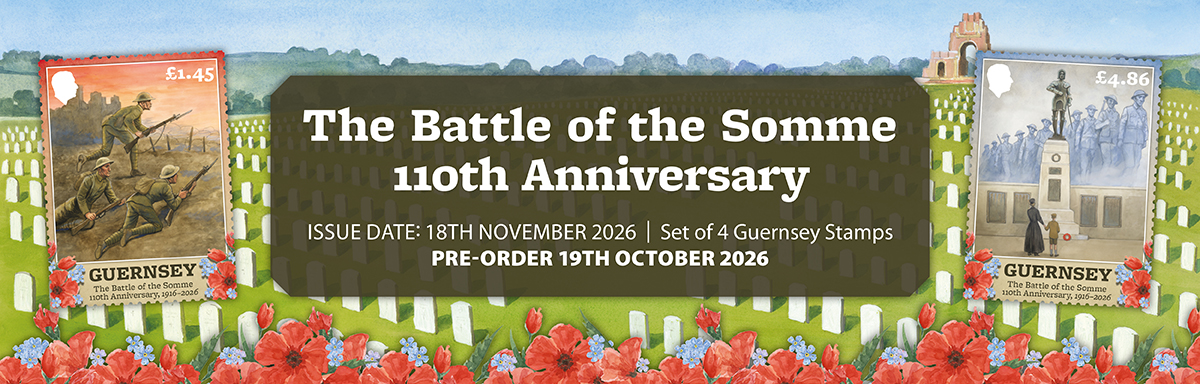
When the First World War began, Guernsey’s military contribution took an unusual path. The island’s Militia could not legally be sent overseas, but the States of Guernsey offered trained volunteers to the British Government, on condition that the men should retain their identity as a Guernsey contingent.
Before the Royal Guernsey Light Infantry was formed in December 1916, these volunteers served within existing British Army formations. Many found themselves alongside Irish comrades in the 6th Battalion, Royal Irish Regiment, while others served as artillerymen in the Divisional Ammunition Column of the 9th (Scottish) Division.
Around 240 Guernseymen initially left the island to join the 6th Royal Irish Regiment; their association with the Irish regiment would bring them into some of the fiercest fighting of the Battle of the Somme. Having trained and served alongside their Irish comrades, the Guernseymen of the 6th Royal Irish Regiment were moved south towards the Somme in August 1916. In early September, they took part in the fighting at Guillemont and Ginchy.
The cost to the island was devastating. 19 Guernseymen serving with the 6th Royal Irish Regiment were killed during the early September fighting, or subsequently died of their wounds. Their names are recorded in Guernsey’s Roll of Honour, ensuring that their sacrifice remains part of the island’s collective memory.
Guernsey’s contribution to the Somme was not confined to the infantry, however. The artillerymen serving with the 9th (Scottish) Division’s ammunition column had the vital task of keeping the guns supplied. Working behind the front line, often moving ammunition by horse-drawn wagons, they played an essential part in sustaining the fighting.
The Battle of the Somme represents more than a single episode in Guernsey’s military history. It reveals the different ways in which islanders served: fighting alongside Irish troops, serving in support of a Scottish division and, above all, maintaining a distinct Guernsey identity far from home.
More than a century later, the stamps bring these strands together, commemorating both the service of those who fought and the contribution of those who supported them, while remembering the heavy price paid by the island.
| Date of Issue | 18th November 2026 |
| Designer | Chloe Sarre |
| Printer | bpost |
| Values | 75p, £1.45, £2.96, £4.86 |
| Process | Offset Lithography |
| Stamp Size | 40mm deep x 30mm wide |
| Illustrators | Martin Hargreaves |
| Paper | PVA Gummed 110gsm |
| Sheet | 10 |
| Perforation | 1.1 x 1.667 |
| Cylinder | A |
-400x200.jpg)
-400x200.jpg)
-400x200.jpg)
-400x200.jpg)