-
Loyalty Points

-
Stamp Programmes

-
Sign In

-
Basket
 0 item(s) - £0.00
Your shopping cart is empty!
0 item(s) - £0.00
Your shopping cart is empty!
 0 item(s) - £0.00
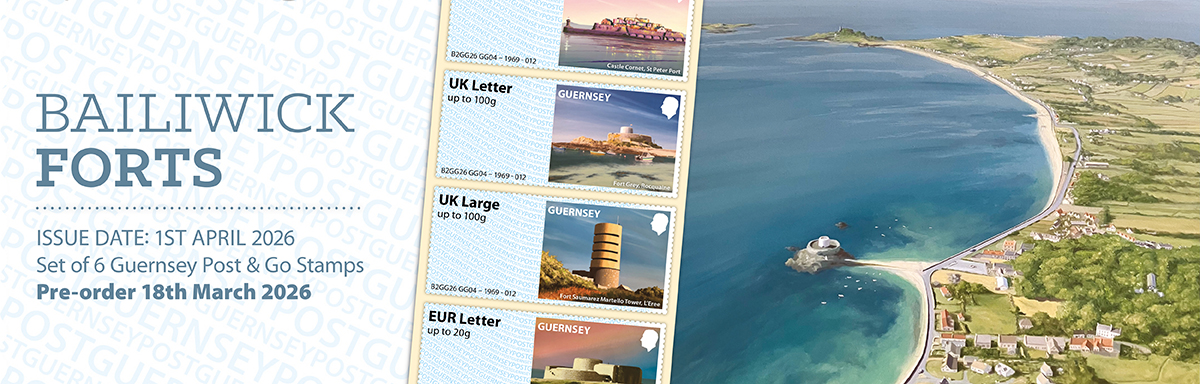
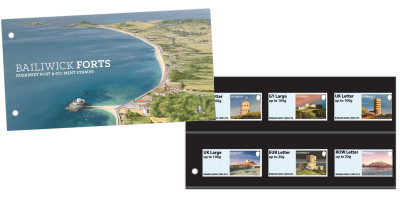
Bailiwick Fortifications:
A landscape shaped by centuries of defence
From medieval strongholds to 20th-century bunkers, the Bailiwick of Guernsey holds one of the richest collections of coastal fortifications in the British Isles. These structures chart centuries of strategic adaptation, reflecting Guernsey’s position on the frontline of European conflict and trade.
The earliest major stronghold, Castle Cornet, was begun in the late 13th century to protect St Peter Port. Expanded and rebuilt many times, especially after a devastating lightning strike in 1672 that ignited its magazine, it remained Guernsey’s principal fortification for hundreds of years. Today, its museums and historic displays reveal the shifting defensive needs of the island across the ages.
By the late 18th century, renewed tension between Britain and France prompted the construction of new coastal defences. In 1778–79 Guernsey built a ring of infantry loophole towers, designed to provide musket fire against enemy landing forces. Their distinctive round profiles remain an instantly recognisable feature of the island’s military heritage.
The Napoleonic era introduced another layer of defence with the arrival of Martello towers. Built at Fort Grey, Fort Hommet and Fort Saumarez, these compact, circular forts were designed to carry a heavy rooftop cannon capable of firing in all directions. They offered stronger coastal surveillance than earlier structures and formed part of a wider British system of standardised coastal fortifications.
The most dramatic change came during the German Occupation (1940–45), when concrete observation posts, casemates and gun emplacements were constructed across the islands as part of the Atlantic Wall. Many of these structures remain preserved as powerful reminders of wartime life and Guernsey’s strategic significance.
Together, the Bailiwick’s forts form a landscape of layered history, from medieval stonework to 20th-century bunkers; telling a continuous story of vigilance, engineering and resilience.
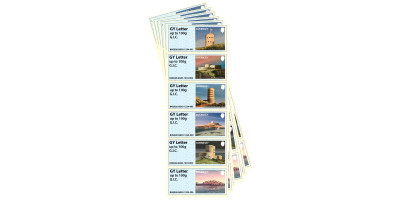
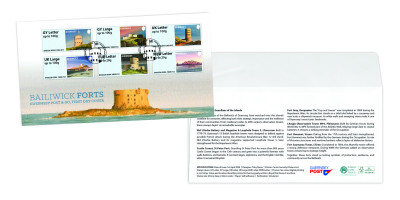
| Date of Issue | 1st April 2026 |
| Designer | Toby Dixon |
| Printer | Cartor Security Printers Ltd |
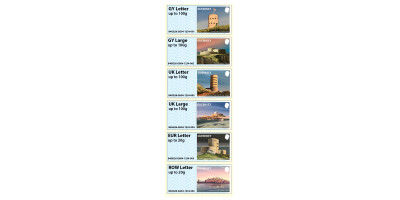
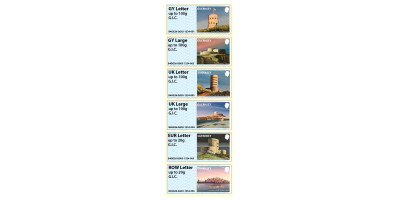
| Values | GY Letter, GY Large, UK Letter, UK Large, EUR Letter, ROW Letter |
| Process | Six colour digital printing in coil strips. Value and location identifier printed in thermography within a Royal Mail Series II machine |
| Stamp Size | 25mm deep x 56mm wide |
| Paper | Self adhesive |
| Perforation | Simulated |